

Send Message
Privacy statement: Your privacy is very important to Us. Our company promises not to disclose your personal information to any external company with out your explicit permission.
 Suzhou Delfino Environmental Technology Co., Ltd.
Select Language
English
Ammonia nitrogen refers to the nitrogen present in water in the form of free ammonia (NH3) and ammonium ions (NH4+). It commonly originates from the decomposition of nitrogen-containing organic matter in domestic sewage, agricultural runoff with nitrogen fertilizers, and emissions from industries such as fertilizer and cement production. Additionally, ammonia-containing exhaust gases from vehicles can dissolve in water, further contributing to ammonia nitrogen contamination.
Ammonia nitrogen in water can be oxidized into nitrite under specific environmental conditions. Long-term ingestion of nitrite-contaminated water may lead to the formation of nitrosamines—potent carcinogens that pose serious health risks. Continuous exposure increases the risk of chronic diseases related to liver and gastrointestinal function.
Free ammonia (NH3) is significantly more toxic to aquatic organisms than ammonium salts. Its toxicity intensifies with increased water temperature and pH levels. Ammonia nitrogen causes both acute and chronic effects on fish and other aquatic species.
Chronic exposure leads to reduced feeding, stunted growth, tissue damage, and impaired oxygen transport. In contrast, acute ammonia poisoning may result in abnormal swimming behavior, loss of equilibrium, convulsions, and eventual death of aquatic life.
To support safe and efficient water quality management, Daruifuno has developed advanced online monitoring tools:
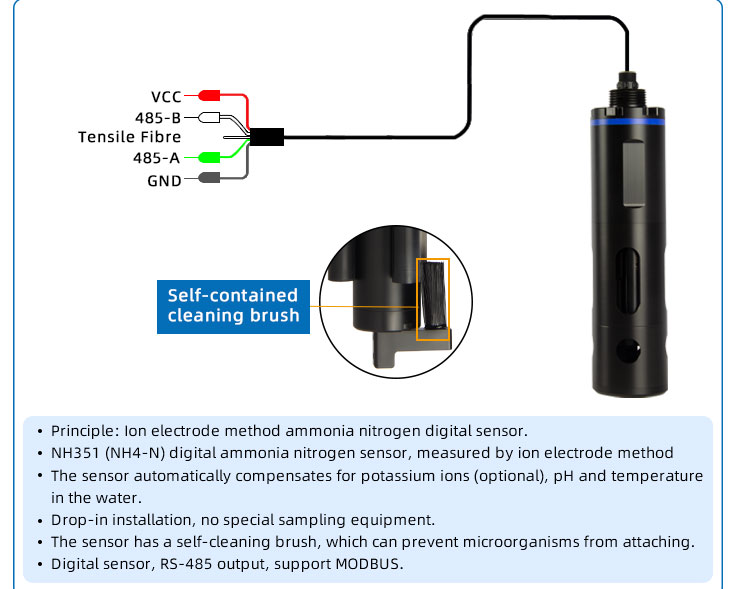
These robust features make Daruifuno’s ammonia nitrogen analyzers ideal for wastewater treatment plants, aquaculture systems, and industrial discharge monitoring. The NH351 sensor, combined with the DUC2-NH4 controller, delivers long-term stable performance and real-time data insights.
Daruifuno specializes in the R&D, manufacturing, and sales of online water quality monitoring instruments. Our core product lines include pH ORP analyzers, turbidity sensors, conductivity meters, dissolved oxygen sensors, COD analyzers, and ammonia nitrogen analyzers. For reliable, accurate, and intelligent water quality solutions, Daruifuno is your trusted partner.
Contact us today to learn more about our ammonia nitrogen sensors and how they can improve your water monitoring systems.
September 25, 2024
August 27, 2024

November 07, 2023
October 20, 2023
In the field of water quality monitoring and analysis, Daruifuno's water quality instrument development team has stringent requirements on the performance of sensors, especially for waterproof...
Overview As a high-precision water quality monitoring device, the signal detection process of fluorescent dissolved oxygen sensor involves knowledge and technology in multiple fields such as optics,...
Introduction to Electrode Glass Membrane The electrode glass membrane, a critical component in pH electrodes, possesses a series of unique properties that make it suitable for use in harsh...
Overview Water quality is a critical factor in environmental protection, industrial processes, and public health. Effective monitoring and control help maintain safe drinking water, optimize...
Email to this supplier
September 25, 2024
August 27, 2024
November 07, 2023
October 20, 2023
About Us
Related Products List
Contact Us

Send Inquiry
Privacy statement: Your privacy is very important to Us. Our company promises not to disclose your personal information to any external company with out your explicit permission.
Fill in more information so that we can get in touch with you faster
Privacy statement: Your privacy is very important to Us. Our company promises not to disclose your personal information to any external company with out your explicit permission.