

Send Message
Privacy statement: Your privacy is very important to Us. Our company promises not to disclose your personal information to any external company with out your explicit permission.
 Shenzhen DOSZ Technology Co., Ltd.
Select Language
English
Turbidity is a key indicator of water quality, measuring the cloudiness or haziness of a fluid due to the presence of suspended particles. These particles scatter light, and the extent of scattering is quantified using different turbidity units. Understanding these units is essential for accurate monitoring and regulatory compliance in water and wastewater treatment applications.
?
NTU stands for Nephelometric Turbidity Units. It represents a measurement of light scattered at a 90-degree angle to the incident light source, typically using a nephelometer. This is the most common turbidity unit used in water treatment plants, particularly in accordance with the USEPA Method 180.1.
The higher the NTU value, the more suspended solids are present in the water. Although turbidity is different from suspended solids (SS), there is a rough correlation: 1 mg/L (or ppm) of SS ≈ 3 NTU. For example, 300 ppm of SS equates to approximately 900 NTU.
According to the World Health Organization (WHO), drinking water should not exceed 5 NTU to ensure safety and clarity.
?
In addition to NTU, several other units are used to measure turbidity, depending on regional standards and instrument types:
All these units are calibrated using the same formazin primary standard. However, differences in instrumentation and light sources lead to variations in measurement results on real water samples.
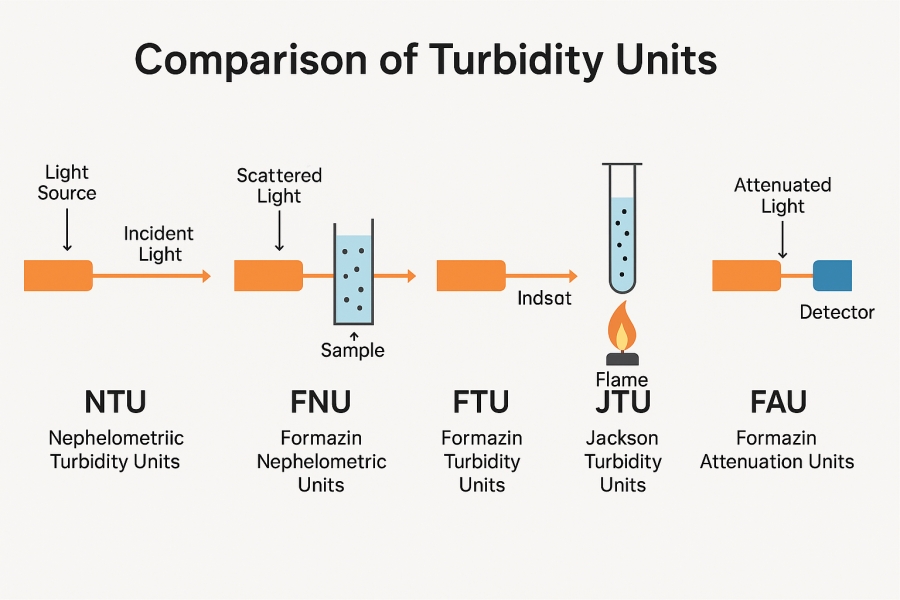
The choice of turbidity unit depends on the application and compliance requirements:
At DOSZ, we design high-precision optical turbidity sensors compatible with both NTU and FNU measurement methods. Our instruments support real-time turbidity monitoring with Modbus or analog output, making them ideal for water treatment plants, industrial discharge monitoring, and environmental protection systems.
Whether you're working with clean drinking water or challenging wastewater conditions, DOSZ's turbidity solutions ensure accuracy, compliance, and long-term reliability.
?
Understanding turbidity units is critical for choosing the right measurement method and equipment. While NTU and FNU dominate the industry today, historical units like JTU and FAU offer context but limited relevance. Trust DOSZ’s advanced turbidity sensors to deliver precise, standards-compliant readings across all water quality applications.

September 25, 2024

August 27, 2024

November 07, 2023

October 20, 2023
In the field of water quality monitoring and analysis, DOSZ's water quality instrument development team has stringent requirements on the performance of sensors, especially for waterproof...
Overview As a high-precision water quality monitoring device, the signal detection process of fluorescent dissolved oxygen sensor involves knowledge and technology in multiple fields such as optics,...
Introduction to Electrode Glass Membrane The electrode glass membrane, a critical component in pH electrodes, possesses a series of unique properties that make it suitable for use in harsh...
Overview Water quality is a critical factor in environmental protection, industrial processes, and public health. Effective monitoring and control help maintain safe drinking water, optimize...
Email to this supplier
September 25, 2024
August 27, 2024
November 07, 2023
October 20, 2023
About Us
Related Products List
Contact Us

Send Inquiry
Privacy statement: Your privacy is very important to Us. Our company promises not to disclose your personal information to any external company with out your explicit permission.
Fill in more information so that we can get in touch with you faster
Privacy statement: Your privacy is very important to Us. Our company promises not to disclose your personal information to any external company with out your explicit permission.