

Send Message
Privacy statement: Your privacy is very important to Us. Our company promises not to disclose your personal information to any external company with out your explicit permission.
 Suzhou Delfino Environmental Technology Co., Ltd.
Select Language
English
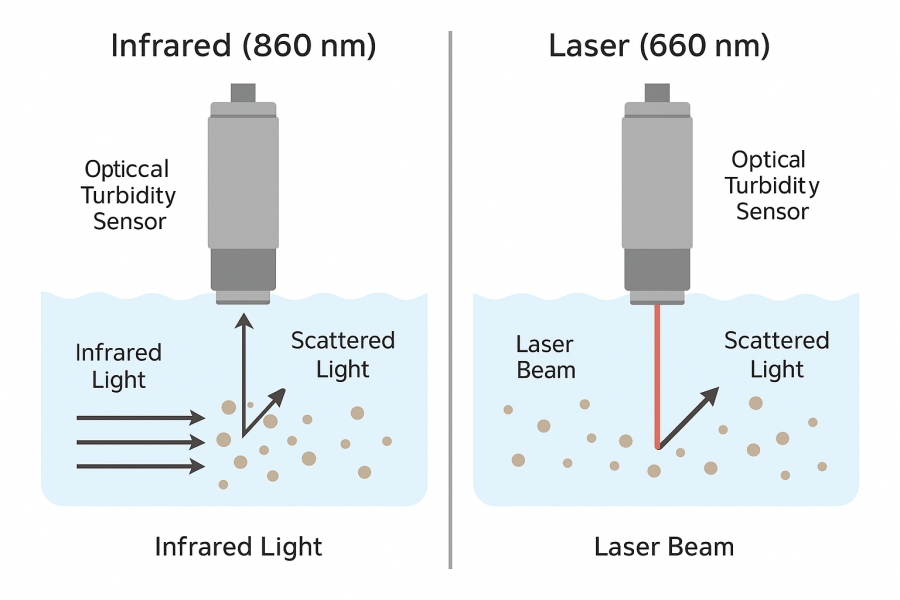
Optical Turbidity Sensors play a critical role in water quality monitoring by detecting the presence of suspended particles through light-based technologies. Two dominant optical principles are widely adopted: infrared light scattering at 860 nm and laser light scattering at 660 nm. Although both methods serve the same purpose—measuring turbidity—they differ in terms of detection sensitivity, application suitability, and overall system design. This article provides a technical comparison of these two approaches to help users make informed decisions based on real-world needs.?
Infrared turbidity sensors operate by emitting light at a wavelength of 860 nanometers. This infrared light passes through the sample and is scattered by suspended particles. The sensor then detects the intensity of the scattered light at specific angles, typically 90°, in accordance with ISO 7027 standards. This method minimizes the impact of sample color and provides stable, repeatable measurements in medium to high turbidity environments.?
In contrast, laser turbidity sensors typically use a narrow beam at a wavelength of 660 nanometers. The coherent and focused nature of laser light allows for more precise scattering analysis, enabling higher sensitivity, especially in ultra-low turbidity applications. Laser-based systems are capable of detecting subtle changes in particle concentration, making them ideal for applications where precision is critical, such as drinking water purification and ultrapure water monitoring.?
The choice between infrared and laser turbidity sensors largely depends on the turbidity range of the application. Infrared-based sensors are better suited for high turbidity environments such as wastewater treatment, stormwater runoff monitoring, or industrial discharge control. Their tolerance to color interference and robust optical design make them reliable for continuous field use.?
On the other hand, laser turbidity sensors are optimized for low to ultra-low turbidity applications, where high resolution and sensitivity are essential. Common use cases include clean water monitoring in municipal treatment plants, semiconductor rinsing processes, and pharmaceutical-grade water production. In these scenarios, even minor deviations in clarity can be critical.?
When comparing performance characteristics, laser-based sensors typically offer faster response times and higher sensitivity due to the precision of the laser beam and advanced photodetection circuitry. These sensors are designed to detect minute variations in particle concentration with minimal noise.?
In contrast, infrared sensors deliver robust performance over a wide turbidity range with strong resistance to environmental variables such as color or light interference. Although they may not match the sensitivity of laser sensors at the very low end, they offer excellent reliability in dynamic and harsh conditions.?
Both infrared and laser Optical Turbidity Sensors provide reliable, contactless turbidity measurements using proven optical principles. The choice between them should be based on application-specific requirements such as turbidity range, sensitivity needs, and environmental stability.?
At Daruifuno, we offer a full range of Optical Turbidity Sensors based on both infrared and laser technologies. Our solutions are designed for integration into various water quality systems, supporting customization, OEM branding, and long-term operational stability.?
Visit our product category to explore available models: Optical Turbidity Sensors at Daruifuno.?

September 25, 2024

August 27, 2024

November 07, 2023

October 20, 2023
In the field of water quality monitoring and analysis, Daruifuno's water quality instrument development team has stringent requirements on the performance of sensors, especially for waterproof...
Overview As a high-precision water quality monitoring device, the signal detection process of fluorescent dissolved oxygen sensor involves knowledge and technology in multiple fields such as optics,...
Introduction to Electrode Glass Membrane The electrode glass membrane, a critical component in pH electrodes, possesses a series of unique properties that make it suitable for use in harsh...
Overview Water quality is a critical factor in environmental protection, industrial processes, and public health. Effective monitoring and control help maintain safe drinking water, optimize...
Email to this supplier
September 25, 2024
August 27, 2024
November 07, 2023
October 20, 2023
About Us
Related Products List
Contact Us

Send Inquiry
Privacy statement: Your privacy is very important to Us. Our company promises not to disclose your personal information to any external company with out your explicit permission.
Fill in more information so that we can get in touch with you faster
Privacy statement: Your privacy is very important to Us. Our company promises not to disclose your personal information to any external company with out your explicit permission.