

Send Message
Privacy statement: Your privacy is very important to Us. Our company promises not to disclose your personal information to any external company with out your explicit permission.
 Suzhou Delfino Environmental Technology Co., Ltd.
Select Language
English
The Dissolved Oxygen Sensor uses optical measurement technology based on the principle of fluorescence quenching. The measurement is reliable and accurate, and does not require frequent calibration. The sensor does not require reagents during use, and the maintenance is small. The only consumption is the replacement of the membrane cover every 1-2 years. In actual application scenarios, the membrane cover will be attached with contaminants after long-term use, causing the measurement to be affected. So how to properly maintain the membrane cover?
Note:
During use, avoid contact of the black coating of the membrane cover with organic solvents, sharp objects or severe impact, otherwise the life of the membrane cover will be reduced.
Cleanin of the membrane cap
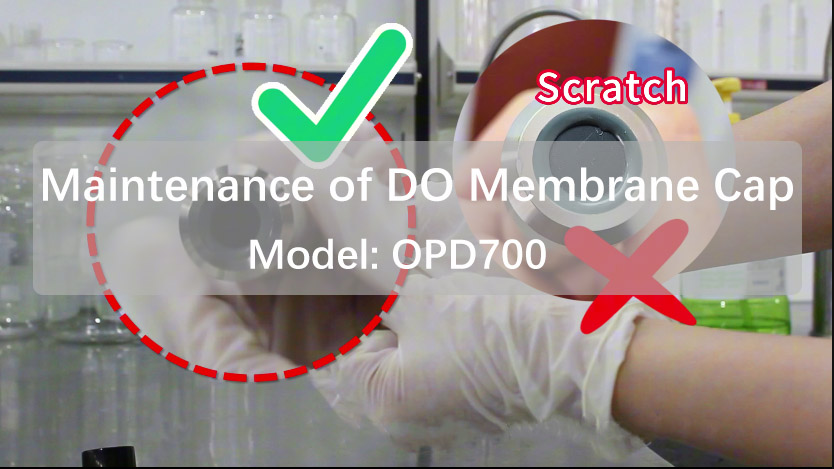
After removing the dissolved oxygen sensor, visually inspect the black round tip of the dissolved oxygen sensor. The black coating should not be scratched or peeled off. Avoid using abrasives to scrub the black coating, and do not wipe it with paper to prevent scratching the membrane cap.
After rinsing with water, gently dry the water with a dust-free cloth. If there is stubborn dirt such as oil or fat, you can use some household detergent to clean it, or soapy water.
Gently rub the membrane cap with the pulp of your fingers or a soft cloth, and finally rinse it with water. Be careful not to use your fingertips to prevent your nails from scratching the membrane cap. If there is something stuck on the membrane cap, you can also use a cotton swab to clean it. Pay attention to the angle and strength of use, and do not scratch the membrane cap with cotton swab.
Note:
Avoid using chlorine-containing detergents. Strong oxidants will bleach the luminescent coating, resulting in reduced intensity and shorten sensor life.
Replacement of membrane cap
If the black coating of the membrane cover is obviously faded, partially peeled off, or the membrane cover is cracked, the membrane cover needs to be replaced.
Unscrew the old membrane cover and replace it with a new one. Check the DO Sensor light window and the red area on the inner surface of the new membrane cover to see if there is any moisture, dust, debris, fiber or other debris. If there is, clean it up and keep it dry before installing the new membrane cover. Usually, recalibration is required after replacing the new membrane cover.
Storage of membrane cap
The dissolved oxygen membrane cap needs to maintain a certain humidity when stored. When the sensor is not in use, the wet sponge protective cover needs to be installed on the sensor for storage.
If the dissolved oxygen sensor is stored dehydrated for a long time, measurement errors or unstable data will occur. It needs to be soaked in water for 48 hours before use.
Delfino focuses on the research and development and production of water quality analysis instruments. Its main products include PH ORP analyzer, conductivity analyzer, turbidity analyzer, COD analyzer, dissolved oxygen analyzer, ammonia analyzer, chlorine analyzer, etc. If you are interested in our products, feel free to cotnact us!
September 25, 2024

August 27, 2024

November 07, 2023

October 20, 2023
In the field of water quality monitoring and analysis, Daruifuno's water quality instrument development team has stringent requirements on the performance of sensors, especially for waterproof...
Overview As a high-precision water quality monitoring device, the signal detection process of fluorescent dissolved oxygen sensor involves knowledge and technology in multiple fields such as optics,...
Introduction to Electrode Glass Membrane The electrode glass membrane, a critical component in pH electrodes, possesses a series of unique properties that make it suitable for use in harsh...
Overview Water quality is a critical factor in environmental protection, industrial processes, and public health. Effective monitoring and control help maintain safe drinking water, optimize...
Email to this supplier
September 25, 2024
August 27, 2024
November 07, 2023
October 20, 2023
About Us
Related Products List
Contact Us

Send Inquiry
Privacy statement: Your privacy is very important to Us. Our company promises not to disclose your personal information to any external company with out your explicit permission.
Fill in more information so that we can get in touch with you faster
Privacy statement: Your privacy is very important to Us. Our company promises not to disclose your personal information to any external company with out your explicit permission.