Home> Industry News> Choosing the Right Dissolved Oxygen Sensor for Your Application

Choosing the Right Dissolved Oxygen Sensor for Your Application

2025,05,29

Overview

Selecting the right dissolved oxygen (DO) sensor is essential for ensuring accurate monitoring and efficient control of oxygen levels in various water-related applications. With numerous sensor types available, understanding your specific needs is critical to achieving reliable data and operational success.?
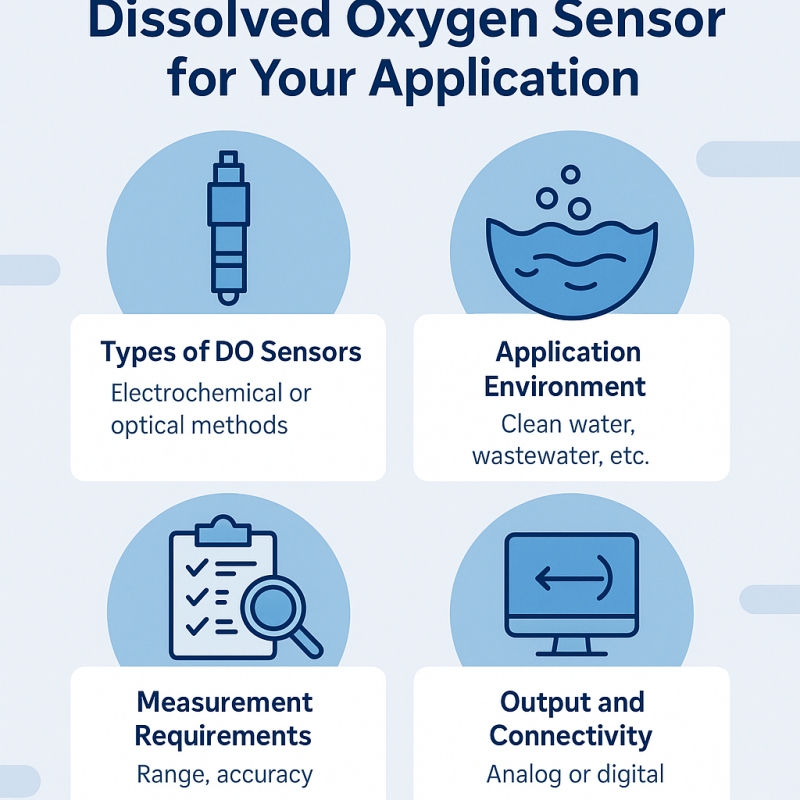
Dissolved Oxygen Sensor for Your Application
?

Understanding Dissolved Oxygen

Dissolved oxygen refers to the amount of free, non-compound oxygen present in water or other liquids. It is a key parameter in water quality assessment, affecting biological activity, chemical reactions, and treatment efficiency. Low DO levels can harm aquatic life and impair treatment processes, while excessive oxygen can lead to scaling and equipment degradation.?
?

Types of Dissolved Oxygen Sensors

Electrochemical DO Sensors

Electrochemical sensors, including galvanic and polarographic types, measure DO through chemical reactions and are ideal for standard environmental or lab testing. They are affordable and well-suited for low-complexity systems but may require frequent calibration and membrane replacement.?

Optical DO Sensors

Optical (luminescent) DO sensors use light to detect oxygen concentrations, offering high stability and low maintenance. These sensors are perfect for continuous monitoring in industrial settings such as wastewater treatment or aquaculture.?
?

Key Factors to Consider When Choosing a DO Sensor

1. Application Environment

Is your application in clean water, wastewater, aquaculture, or an industrial process? Optical sensors are better suited for harsh and dirty environments, while electrochemical types work well in clean or controlled settings.?

2. Measurement Range and Accuracy

Choose a sensor with the appropriate DO measurement range and accuracy based on your system's requirements. Industrial applications may demand higher precision, while basic testing can accept standard ranges.?

3. Maintenance Requirements

Consider how often the sensor needs cleaning, calibration, or membrane replacement. Optical sensors generally require less maintenance compared to electrochemical ones.?

4. Output Type and Connectivity

Modern DO sensors may come with analog or digital outputs (e.g., Modbus, 4-20 mA). Ensure compatibility with your SCADA, PLC, or data logging system.?
?

Applications of DO Sensors

DO sensors are widely used in wastewater treatment plants, aquaculture farms, environmental monitoring, industrial process control, and laboratory analysis. Each of these applications has specific demands, making the sensor selection process critical for optimal performance.?
?

Why Choose Daruifuno DO Sensors?

Daruifuno offers a full range of dissolved oxygen sensors tailored to different applications. Our optical and electrochemical sensors deliver high precision, durability, and easy integration with control systems. Whether you're monitoring a municipal wastewater plant or managing an aquaculture system, Daruifuno provides solutions that are accurate, cost-effective, and reliable.?
?

Conclusion

Choosing the right Dissolved Oxygen Sensor ensures consistent and efficient water quality management. Consider your application environment, maintenance capabilities, and system compatibility before making your decision. For a full overview of sensor options, visit our Dissolved Oxygen Sensors category page.?
Contact Us

Author:

Ms. Selena

Phone/WhatsApp:

++86 18013144571

Popular Products
You may also like
Related Information
Daruifuno Sensor & Probe-Pressure and Waterproof Test

In the field of water quality monitoring and analysis, Daruifuno's water quality instrument development team has stringent requirements on the performance of sensors, especially for waterproof...

Signal detection and temperature compensation calibration of fluorescent dissolved oxygen sensor

Overview As a high-precision water quality monitoring device, the signal detection process of fluorescent dissolved oxygen sensor involves knowledge and technology in multiple fields such as optics,...

The Characteristics and Applications of Electrode Glass Membrane

Introduction to Electrode Glass Membrane The electrode glass membrane, a critical component in pH electrodes, possesses a series of unique properties that make it suitable for use in harsh...

Water Quality Monitoring and Control: Optimizing Water Treatment with Sensors

Overview Water quality is a critical factor in environmental protection, industrial processes, and public health. Effective monitoring and control help maintain safe drinking water, optimize...

Related Categories

Email to this supplier

Subject:
Email:
Message:

Your message must be between 20-8000 characters

We will contact you immediately

Fill in more information so that we can get in touch with you faster

Privacy statement: Your privacy is very important to Us. Our company promises not to disclose your personal information to any external company with out your explicit permission.

Send