

Send Message
Privacy statement: Your privacy is very important to Us. Our company promises not to disclose your personal information to any external company with out your explicit permission.
 Suzhou Delfino Environmental Technology Co., Ltd.
Select Language
English
In modern aquaculture, maintaining optimal water quality is crucial for fish health and growth. One of the most critical parameters is dissolved oxygen (DO). A Dissolved Oxygen Sensor provides real-time monitoring and control of DO levels, ensuring that aquaculture and aeration systems operate efficiently and sustainably.
A dissolved oxygen sensor, or DO Sensor, is a water quality sensor that measures the concentration of oxygen dissolved in water. It is an essential tool in aquaculture for detecting oxygen levels to prevent hypoxia and ensure optimal conditions for aquatic life. Sensors typically use optical or electrochemical methods to provide accurate and continuous DO readings.
Modern DO sensors often rely on optical technology. An internal light source excites a luminescent dye, and the presence of oxygen quenches the fluorescence. By measuring the intensity or decay rate of the emitted light, the sensor calculates the oxygen concentration in the water. This method offers excellent accuracy, stability, and low maintenance, making it ideal for aquaculture environments.
Using dissolved oxygen sensors in aquaculture operations provides several benefits:
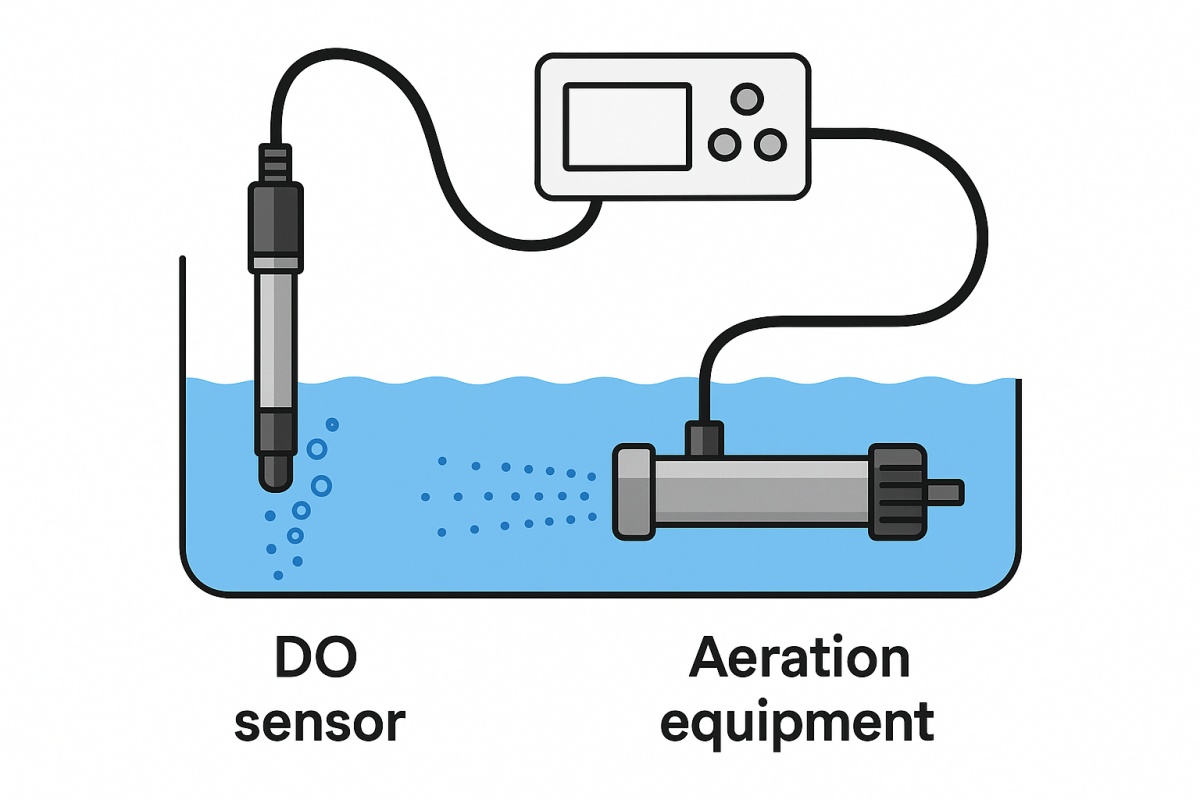
In intensive fish farming, oxygen demand varies with temperature, biomass, and feeding schedules. A DO sensor communicates with the aeration system to supply just the right amount of oxygen, avoiding under-aeration (which risks fish health) and over-aeration (which wastes energy). This improves energy efficiency and operational costs.
Dissolved oxygen sensors are used across various aquaculture setups:
Integrating a dissolved oxygen sensor into aquaculture operations brings measurable benefits in productivity, energy efficiency, and fish welfare. When paired with intelligent aeration systems, these sensors enable automated and data-driven oxygen management, essential for sustainable aquaculture growth. As technology advances, DO sensors continue to play a vital role in precision aquaculture and efficient water quality control.
September 25, 2024
August 27, 2024

November 07, 2023

October 20, 2023
In the field of water quality monitoring and analysis, Daruifuno's water quality instrument development team has stringent requirements on the performance of sensors, especially for waterproof...
Overview As a high-precision water quality monitoring device, the signal detection process of fluorescent dissolved oxygen sensor involves knowledge and technology in multiple fields such as optics,...
Introduction to Electrode Glass Membrane The electrode glass membrane, a critical component in pH electrodes, possesses a series of unique properties that make it suitable for use in harsh...
Overview Water quality is a critical factor in environmental protection, industrial processes, and public health. Effective monitoring and control help maintain safe drinking water, optimize...
Email to this supplier
September 25, 2024
August 27, 2024
November 07, 2023
October 20, 2023
About Us
Related Products List
Contact Us

Send Inquiry
Privacy statement: Your privacy is very important to Us. Our company promises not to disclose your personal information to any external company with out your explicit permission.
Fill in more information so that we can get in touch with you faster
Privacy statement: Your privacy is very important to Us. Our company promises not to disclose your personal information to any external company with out your explicit permission.