

Send Message
Privacy statement: Your privacy is very important to Us. Our company promises not to disclose your personal information to any external company with out your explicit permission.
 Suzhou Delfino Environmental Technology Co., Ltd.
Select Language
English
Ensuring safe and clean drinking water is a critical task in modern water treatment systems. One essential parameter for water safety is the concentration of residual chlorine — a disinfectant commonly used to eliminate bacteria and pathogens. Residual chlorine sensors play a vital role in real-time monitoring of disinfectant levels in municipal water supplies, helping utilities maintain effective treatment while preventing health risks from both under- and over-chlorination.
?
A residual chlorine sensor, also known as a free chlorine sensor, is a water quality monitoring device designed to measure the concentration of chlorine remaining in treated water after the disinfection process. This residual chlorine helps to ensure continued microbial control as water travels through distribution networks to consumers. These sensors are essential in safeguarding public health by confirming that chlorine levels remain within safe and regulated limits.
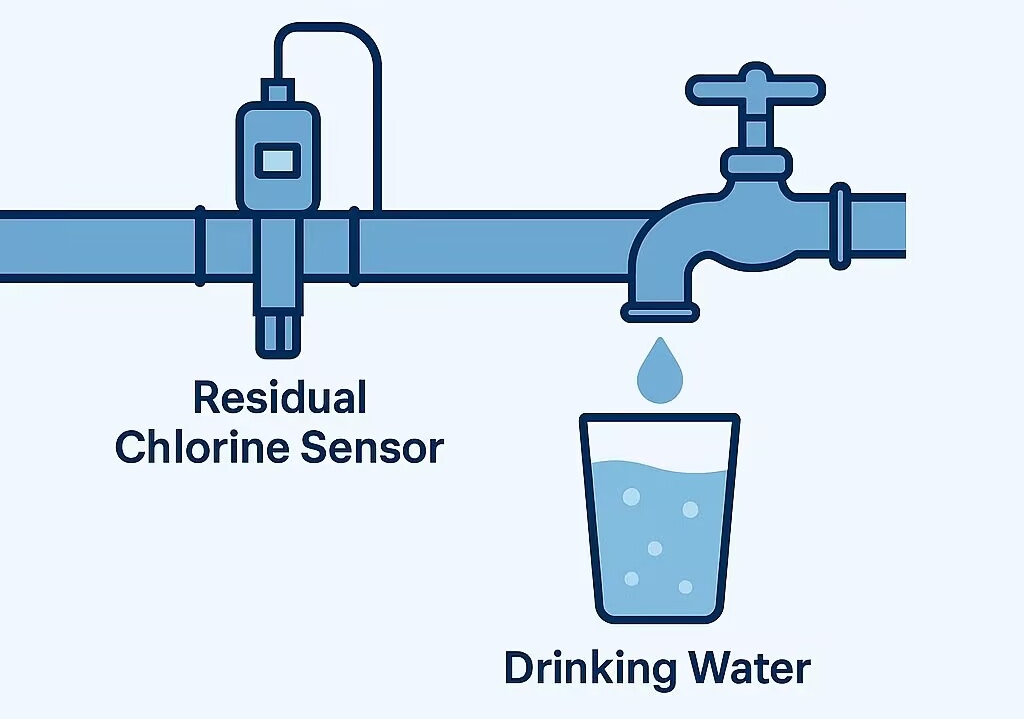
Most modern residual chlorine sensors operate based on amperometric measurement principles. The sensor consists of a membrane-covered electrode that detects chlorine via electrochemical reactions. As chlorine diffuses through the membrane, it reacts at the electrode surface, generating a current proportional to the concentration of chlorine in the sample.
Residual chlorine measurement is a key component of water treatment systems, especially in drinking water facilities. These sensors are widely installed at:
By providing continuous, online monitoring, residual chlorine sensors allow operators to:
Our residual chlorine sensors offer high stability, low maintenance, and excellent compatibility with various water conditions. Designed for easy integration into online monitoring systems, they are ideal for municipal and industrial water treatment applications. Our portfolio includes sensors with automatic temperature compensation, digital output, and advanced diagnostics to ensure long-term accuracy and reliability.
In summary, residual chlorine sensors are essential tools for ensuring the safety and quality of drinking water. By providing accurate, real-time measurements, these sensors help treatment facilities maintain optimal chlorine levels, protecting public health and improving operational efficiency. Integrating residual chlorine monitoring into water systems is a smart step toward safer, cleaner water for all.

September 25, 2024

August 27, 2024

November 07, 2023

October 20, 2023
In the field of water quality monitoring and analysis, Daruifuno's water quality instrument development team has stringent requirements on the performance of sensors, especially for waterproof...
Overview As a high-precision water quality monitoring device, the signal detection process of fluorescent dissolved oxygen sensor involves knowledge and technology in multiple fields such as optics,...
Introduction to Electrode Glass Membrane The electrode glass membrane, a critical component in pH electrodes, possesses a series of unique properties that make it suitable for use in harsh...
Overview Water quality is a critical factor in environmental protection, industrial processes, and public health. Effective monitoring and control help maintain safe drinking water, optimize...
Email to this supplier
September 25, 2024
August 27, 2024
November 07, 2023
October 20, 2023
About Us
Related Products List
Contact Us

Send Inquiry
Privacy statement: Your privacy is very important to Us. Our company promises not to disclose your personal information to any external company with out your explicit permission.
Fill in more information so that we can get in touch with you faster
Privacy statement: Your privacy is very important to Us. Our company promises not to disclose your personal information to any external company with out your explicit permission.