

Send Message
Privacy statement: Your privacy is very important to Us. Our company promises not to disclose your personal information to any external company with out your explicit permission.
 Suzhou Delfino Environmental Technology Co., Ltd.
Select Language
English
In the water treatment industry where disinfectants are used, we often hear about residual chlorine and total chlorine. Are they the same? Can a free chlorine sensor be used to monitor total chlorine? Today, we will explore the differences between residual chlorine and total chlorine.
Residual chlorine refers to the content of free chlorine in water, which is the residual amount of disinfectants (such as chlorine gas, sodium hypochlorite, etc.) in water. Residual chlorine can effectively kill bacteria, viruses, and other microorganisms in water to ensure the safety of water quality.
Total chlorine refers to the sum of free chlorine and combined chlorine in water, including free chlorine, sodium hypochlorite, hypochlorous acid, chloride, etc.
Total chlorine is an index to measure the chloride content in water and evaluate the degree of organic pollution in water quality. Measuring total chlorine can help determine whether there is enough disinfectant in the water.
Residual chlorine, on the other hand, is used as a disinfectant, and measuring residual chlorine helps determine whether the residual amount of disinfectant is appropriate.
The measurement of total chlorine is usually greater than the measurement of free chlorine because total chlorine includes all chloride compounds, while free chlorine only includes chlorine that is not consumed.
A residual Chlorine Sensor monitors residual chlorine and is mainly used in water treatment processes, such as water plants, swimming pools, and drinking water processing.
A Total Chlorine Sensor monitors total chlorine and is primarily used in environmental monitoring and water quality assessment, such as the monitoring of rivers, lakes, oceans, and pollution sources like industrial wastewater and agricultural discharge.
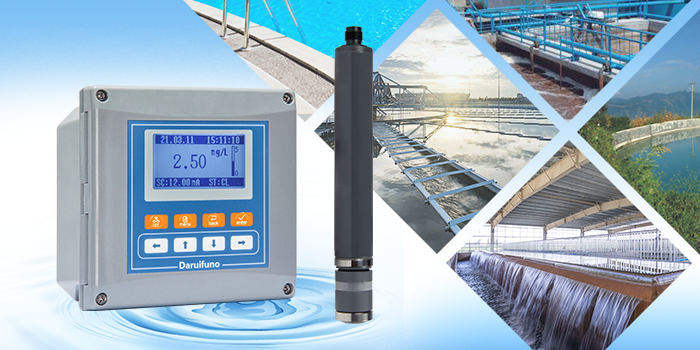
Although there are many differences, residual chlorine and total chlorine are also related in practical applications. Because residual chlorine is the part of free chlorine in total chlorine, in some occasions, it is necessary to monitor the values of both residual chlorine and total chlorine simultaneously to fully understand the water quality. Our company provides both chlorine sensors and total chlorine sensors, along with matched controllers.
Our company focuses on the R&D, production, and sales of water quality analysis instruments. Our main products include:
If you need water treatment-related products, please contact us.

September 25, 2024

August 27, 2024

November 07, 2023

October 20, 2023
In the field of water quality monitoring and analysis, Daruifuno's water quality instrument development team has stringent requirements on the performance of sensors, especially for waterproof...
Overview As a high-precision water quality monitoring device, the signal detection process of fluorescent dissolved oxygen sensor involves knowledge and technology in multiple fields such as optics,...
Introduction to Electrode Glass Membrane The electrode glass membrane, a critical component in pH electrodes, possesses a series of unique properties that make it suitable for use in harsh...
Overview Water quality is a critical factor in environmental protection, industrial processes, and public health. Effective monitoring and control help maintain safe drinking water, optimize...
Email to this supplier
September 25, 2024
August 27, 2024
November 07, 2023
October 20, 2023
About Us
Related Products List
Contact Us

Send Inquiry
Privacy statement: Your privacy is very important to Us. Our company promises not to disclose your personal information to any external company with out your explicit permission.
Fill in more information so that we can get in touch with you faster
Privacy statement: Your privacy is very important to Us. Our company promises not to disclose your personal information to any external company with out your explicit permission.