

Send Message
Privacy statement: Your privacy is very important to Us. Our company promises not to disclose your personal information to any external company with out your explicit permission.
 Suzhou Delfino Environmental Technology Co., Ltd.
Select Language
English
turbidity refers to the degree of obstruction of a solution to the passage of light, which includes the scattering of light by suspended matter and the absorption of light by solute molecules. The turbidity of water is not only related to the content of suspended substances in the water, but also to their size, shape and refractive index. Turbidity is usually suitable for water quality determination of natural water, drinking water and some industrial water. So what is the safe range of turbidity for drinking water?
The average user has only a vague concept of turbidity and does not have professional instruments to monitor it, but from the sensors we know that drinking water should not be turbid and should not have impurities visible to the naked eye. In fact, turbidity is simple and easy to measure, and it is also one of the core indicators for measuring the quality of water. It is not only and indicator reflecting the physical properties of drinking water, used to indicate the clarity or turbidity of water, but also an indirect microbiological indicator. Turbidity not only reflects the concentraction level of microorganisms in the water, but also directly affects the inactivation effects of disinfection on pathogenic microorganisms.
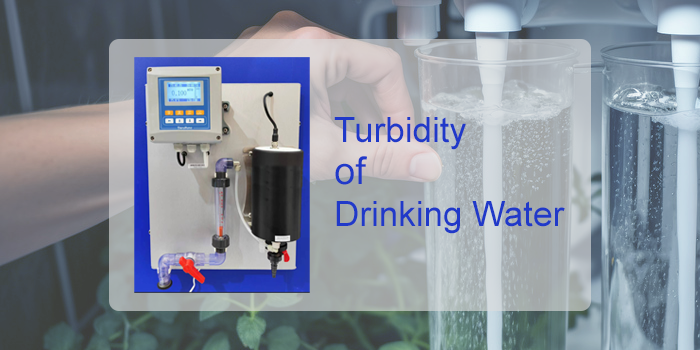
Unclean water may contain viruses, pathogenic microorganisms such as E.coli, Cryptosporidium, and Giardia. Since these microorganisms are also a component of turbidity. It is generally believed that when the turbidity of water is lower than 0.3NTU, the concentraction of pathogenic microorganisms in it will be very low. In addition, disinfection is an indispensable technical means to control pathogenic microorganisms in water. When the turbidity value of water is lower than 1NTU, due to the samll shielding effect of colloidal substances in the water, the inactivation effect and guarantee rate of pathogenic microorganisms during disinfection are higher. Therefore, water turbidity is not only a sensory indicator, but also an indirect microbiological indicator.
Based on the above scientific understanding of turbidity, China's "Drinking Water Hygienic Standards" and the world health organization's "Drinking Water Quality Standards" set the maximum turbidity limit for drinking water at 1 NTU. At the same time, major water supply companies have set the internal turbidity control index value of factory water at 0.3NTU or even lower, effectively ensuring the safety of water supply and eliminating the risk of drinking water microorganisms.
The OLTU600 laser turbidity sensor developed and produced by daruifuno has a compact and miniaturized design with small installation space and is conducive to integration. Using 660nm laser light source, it has high resolution and fast response. As an online measurement instrument, the turbidity analyzer can continously monitor the turbidity value of water quality 24 hours a day. When used with our DUC2-TU online turbidity controler, it can realize the functions of display, control and transmission. The measurement range of this turbidity analyzer is 0.001~100NTU, which is specially designed for low turbidity water quality such as drinking water, tap water, etc.
The above is an introduction to the safe range of drinking water turbidity. If you are interested in our products, please contact us. We also provide the online pH ORP meter, conductivity analyzer, dissolved oxygen analyzer, COD analyzer, ammonia analyzer, chlorine analyzer, etc..

September 25, 2024
August 27, 2024

November 07, 2023

October 20, 2023
In the field of water quality monitoring and analysis, Daruifuno's water quality instrument development team has stringent requirements on the performance of sensors, especially for waterproof...
Overview As a high-precision water quality monitoring device, the signal detection process of fluorescent dissolved oxygen sensor involves knowledge and technology in multiple fields such as optics,...
Introduction to Electrode Glass Membrane The electrode glass membrane, a critical component in pH electrodes, possesses a series of unique properties that make it suitable for use in harsh...
Overview Water quality is a critical factor in environmental protection, industrial processes, and public health. Effective monitoring and control help maintain safe drinking water, optimize...
Email to this supplier
September 25, 2024
August 27, 2024
November 07, 2023
October 20, 2023
About Us
Related Products List
Contact Us

Send Inquiry
Privacy statement: Your privacy is very important to Us. Our company promises not to disclose your personal information to any external company with out your explicit permission.
Fill in more information so that we can get in touch with you faster
Privacy statement: Your privacy is very important to Us. Our company promises not to disclose your personal information to any external company with out your explicit permission.