

Send Message
Privacy statement: Your privacy is very important to Us. Our company promises not to disclose your personal information to any external company with out your explicit permission.
 Suzhou Delfino Environmental Technology Co., Ltd.
Select Language
English
In the water treatment industry, we often hear about pure water and ultrapure water, so what is the difference between them? Whether it is pure water or ultrapure water, the conductivity value is a standard to measure the difference between them. How to monitor the conductivity value of pure water and ultrapure water? The ASCK stainless steel series online conductivity sensors developed and produced by Daruifuno have different K constants for different applications. Usually the conductivity value of pure water and ultrapure water is very low, and a Conductivity Sensor with a K constant of 0.01 is required. In addition, temperature has a great influence on the measurement of conductivity values, so the Conductivity Probe has a built-in PT1000 high-precision temperature sensor. Next, let's talk about the concepts of pure water and ultrapure water.
Pure water refers to water with extremely high chemical purity. From a chemical point of view, it only contains H2O and contains almost no other substances. It is mainly used in biology, chemistry, metallurgy, aerospace, electricity and other fields, but it has high water purity requirements. It is quite high, so it is generally most widely used in the electronics industry. The conductivity of pure water is generally less than 2μS/cm. To monitor such a low conductivity value, a stainless steel conductivity electrode must be used. The ASCK-K0.01 model online conductivity electrode is designed for monitoring the conductivity value of pure water. In the production process of pure water, anions and cations in the water can be removed by electrodialysis, reverse osmosis and ion exchange resin technology. Particles in water can generally be removed by technologies such as ultrafiltration and membrane filtration. Bacteria in water are currently generally removed by dosing or ultraviolet light irradiation or Ozone sterilization. Toc in water is generally treated with activated carbon and reverse osmosis. In the field of pure water applications, the purity of water is directly related to the performance of the device. The reliability threshold voltage, resulting in low voltage breakdown, defects, and also affects the service life of the material. Therefore, pure water requires very purity and precision.
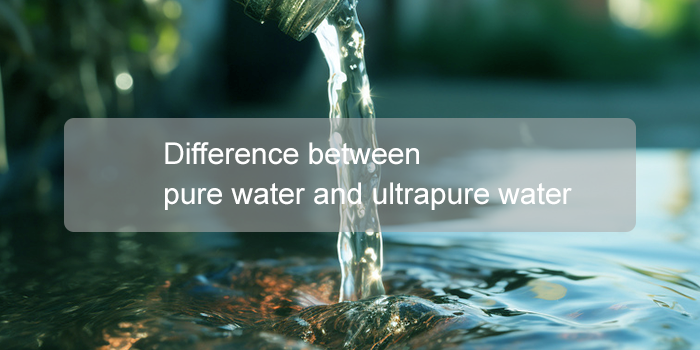
Ultrapure water is based on pure water and further removes the conductive medium in the water almost completely, and removes the non-dissociated colloidal substances, gases and organic matter in the water to a very low level. The resistivity is greater than 18MΩ*cm or close to the limit value of 18.25MΩ*cm. Ultrapure water is level that is difficult to achieve with general process. Two or more technologies from microfiltration technology, ultrafiltration technology, reverse osmosis technology, EDI technology, and ion exchange technology. Usually, to monitor the conductivity of ultrapure water, a conductivity electrode with a K constant of 0.01 is required. The ASCK series conductivity electrodes developed and produced by Daruifuno, among which the electrode with K constant 0.01, can accurately measure the conductivity value of ultrapure water.
The above is about the differences between pure water and ultrapure water. Pure water is usually used in domestic drinking water, food factory water, pharmaceutical manufacturing, swimming pool facilities, circulating cooling water and other occasions. Therefore, it is very important to have a reliable pure water conductivity sensor. If you are interested in our online conductivity electrode, please contact us. Daruifuno focuses on the R&D and production of water quality analysis instruments. The main products are pH ORP analyzer, conductivity analyzer, turbidity analyzer, COD analyzer, dissolved oxygen analyzer, ammonia analyzer, chlorine analyzer, etc.

September 25, 2024
August 27, 2024

November 07, 2023
October 20, 2023
In the field of water quality monitoring and analysis, Daruifuno's water quality instrument development team has stringent requirements on the performance of sensors, especially for waterproof...
Overview As a high-precision water quality monitoring device, the signal detection process of fluorescent dissolved oxygen sensor involves knowledge and technology in multiple fields such as optics,...
Introduction to Electrode Glass Membrane The electrode glass membrane, a critical component in pH electrodes, possesses a series of unique properties that make it suitable for use in harsh...
Overview Water quality is a critical factor in environmental protection, industrial processes, and public health. Effective monitoring and control help maintain safe drinking water, optimize...
Email to this supplier
September 25, 2024
August 27, 2024
November 07, 2023
October 20, 2023
About Us
Related Products List
Contact Us

Send Inquiry
Privacy statement: Your privacy is very important to Us. Our company promises not to disclose your personal information to any external company with out your explicit permission.
Fill in more information so that we can get in touch with you faster
Privacy statement: Your privacy is very important to Us. Our company promises not to disclose your personal information to any external company with out your explicit permission.